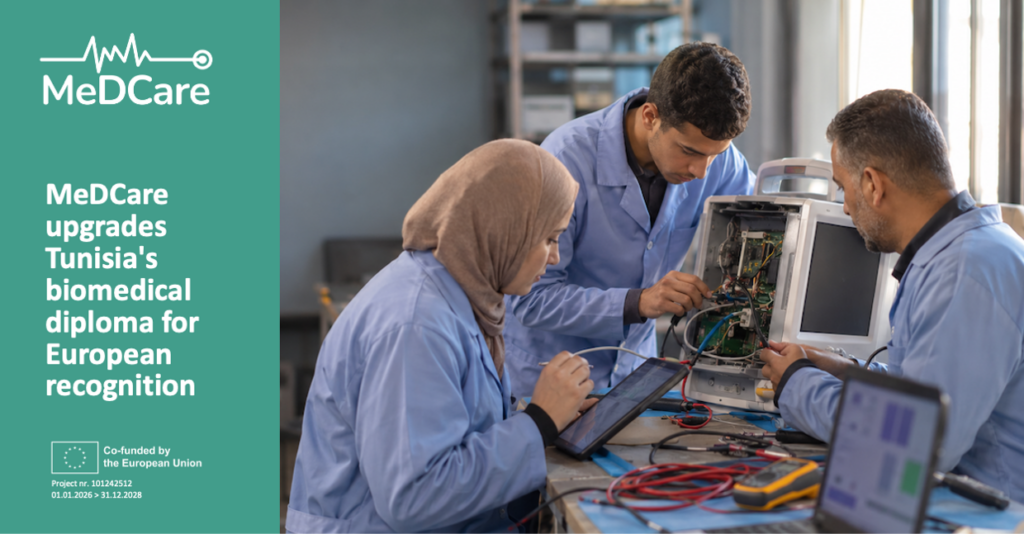
Tunisia’s diploma of Higher Technician in Biomedical Equipment Maintenance has been training the country’s hospital technology professionals for years. What it lacks is a step forward: a structured integration of digital health competences and a recognition that travels beyond the Mediterranean. The MeDCare project, funded by the Erasmus+ programme under its Capacity Building in VET action, is working with Tunisian institutions to evolve this diploma into a qualification with dual recognition, valid in Tunisia and across Europe. The research phase that prepares the curriculum update has now moved into its operational stage.
The defining feature of the project is dual recognition. Once defined and validated, the upgraded diploma will be recognised by Tunisia through its National Qualifications Framework and by Europe through the European Qualifications Framework at EQF Level 5, with the support of Europass and ESCO. Holding the two frameworks together will be a Memorandum of Understanding, signed at the end of the project by ITS, Société Al Emtiez and ATFP. For Tunisian students, this means credentials with European value, with a direct impact on professional mobility and employment prospects. For the Tunisian healthcare system, it means training standards that are comparable to European ones, in a sector going through profound digital transformation.
Upgrading an existing diploma is not a cosmetic exercise. It requires understanding how clinical and technical practice has changed in recent years, which competences have entered the daily work of biomedical technicians, and which obstacles make their acquisition difficult. This is the task of the ongoing research phase, coordinated by OpenCom, devoted to mapping the competences required and analysing the barriers shaping advanced biomedical training in Tunisia. The work is structured in four sequential stages. The first, completed in April 2026, was a desk study led by ATFP that systematised public policies, sector data and existing training pathways. The second, currently led by Elemtiez, involves two focus groups with ten experts, including doctors from smart hospitals, biomedical technicians, trainers and policy makers. The third stage, led by ATAS, is now opening: 30 semi-structured interviews, held in person or by video call, distributed across 15 healthcare facilities, 10 vocational training providers and 5 national and regional authorities. The fourth stage, from August onwards, will be the synthesis led by OpenCom, producing the final report by the end of September 2026.
The scope of the research is anchored to the ESCO 2149.5 profile (Biomedical Engineering Specialist), rescaled to EQF Level 5 and enriched with the competences specific to digital health: telemedicine, health information systems, connected medical devices, clinical data protection. One dimension runs through the entire research design, the analysis of gender disparities in access to biomedical careers, integrated across all phases rather than treated as a separate chapter.
“We start from a real foundation, the Tunisian diploma in biomedical equipment maintenance, which already has its own history and identity”, says Erina Guraziu, head of the research phase at OpenCom. “Our work is to understand where that professional profile needs to evolve to meet the digital transformation of the healthcare sector, and how to structure the update in line with European standards. That is why we chose a qualitative approach that places at its centre the voices of those who inhabit that world every day: listening to the Tunisian healthcare system, its trainers and its authorities is the only way to build a genuinely sustainable upgrade”.
The MeDCare consortium brings together six partners from Italy, Spain and Tunisia, coordinated by ITS, the Italian institute specialised in EQF Level 5 higher technical education in the life sciences. Associated partners are Clinique Les Anges in Tunisia and Gruppo San Donato in Italy.
MeDCare aligns with the priorities of the European Union’s Global Gateway for the southern Mediterranean, in particular the Flagships devoted to the social sectors and to digital transformation, and contributes to the Agenda for the Mediterranean that governs cooperation between the European Union and the southern neighbourhood.
The findings of the research will feed into the co-design phase of the upgraded curriculum for the dual-recognition diploma, starting in autumn 2026.