
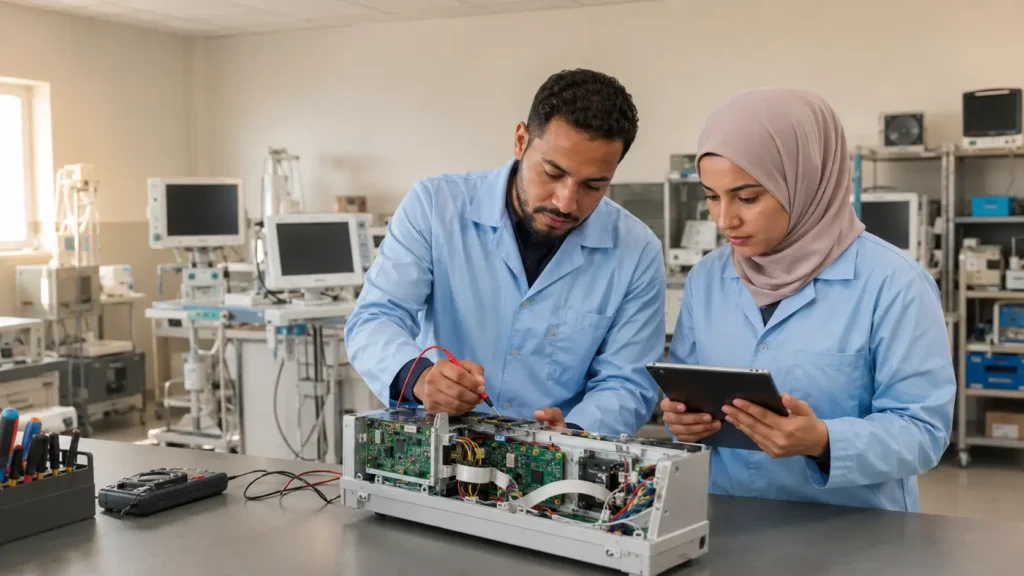
In a diagnostic imaging unit, a piece of equipment fails. Getting it back into service quickly is not simply a technical matter: the continuity of care depends on that very skill. It is in this very concrete space, where healthcare technology meets vocational training, that MeDCare begins.
A European project that, over the next three years, will work to train technicians in Tunisia who can install, run and maintain the technologies now found throughout hospitals and laboratories.
What MeDCare is
MeDCare creates a new double-degree professional profile at EQF Level 5, the “Medical Technology & Digital Health Care Technician”, built by strengthening and modernising the biomedical training already present within Tunisia’s vocational education and training system.
This is not a matter of starting from scratch, but of growing an existing pathway and bringing it up to what hospitals and industry now expect: increasingly digital equipment, advanced diagnostics, and the integrated management of healthcare technologies. The programme is aligned with Industry 4.0 standards and with European VET frameworks.
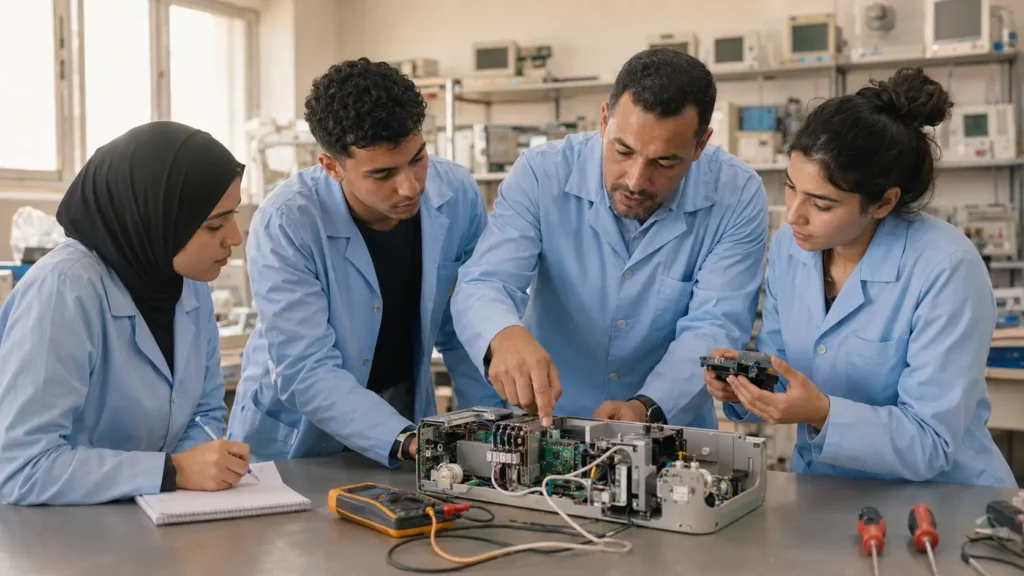
A Euro-Tunisian consortium
Six organisations from three countries pool complementary strengths, from curriculum design and research to hands-on training and deep local roots in Tunisia.
Objectives and tools
General objective
To enhance the quality, relevance and responsiveness of Tunisia’s vocational training system in the biomedical and digital healthcare sectors, by developing and delivering a double-degree pathway for “Medical Technology & Digital Health Care Technicians”, aligned with Industry 4.0 standards and European frameworks, in support of the modernisation of the healthcare sector.
Assess the needs
Study healthcare technology skills and the barriers to their uptake across Tunisia’s medical sector.
Co-design the curriculum
Develop an innovative EQF Level 5 pathway together with European partners.
Strengthen the centres
Equip training sites with virtual-reality environments, AI tools and up-to-date biomedical equipment.
Train the trainers
Prepare Tunisian trainers in digital health technologies and innovative teaching methods.
Pilot the pathway
Test the double-degree with students, certifying learning through blockchain micro-credentials.
Ensure continuity
Put agreements in place for the programme’s sustainability and share results across European networks.
Virtual reality
Immersive environments to practise on equipment safely.
Artificial intelligence
Tools to support teaching and learning.
Micro-credentials
Digital certification on blockchain, with Europass.
Skills that count on both shores
What sets the pathway apart is its dual recognition. Learning outcomes are validated by European institutions while remaining fully compatible with Tunisia’s national qualifications system, thanks to the involvement of ATFP and the use of digital micro-credentials and Europass.
For young technicians, this means skills that are legible on both shores of the Mediterranean: a tangible contribution to the recognition of qualifications between countries, and to the chance of building a skilled career starting from one’s own region.